Introduction to Kant's Critique of Pure Reason
by Dr. Claudia Krenz

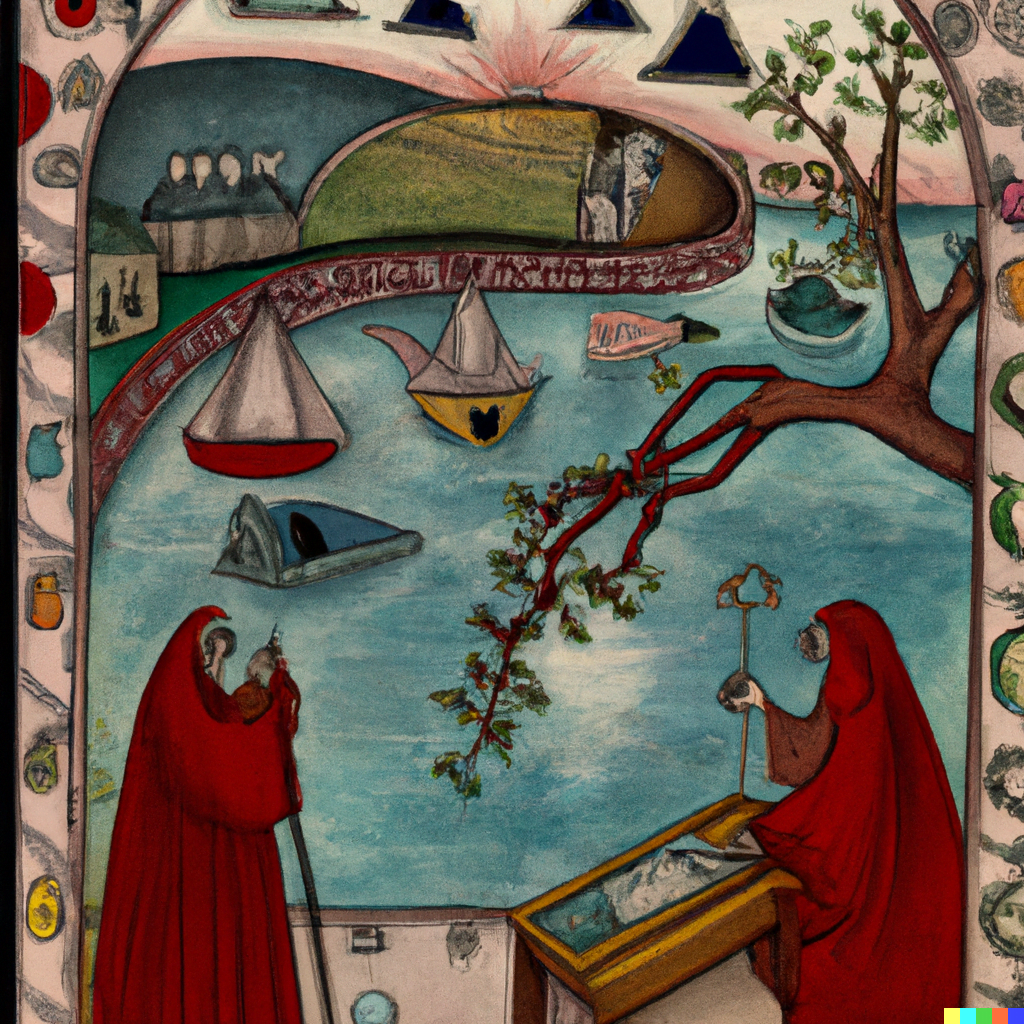
We rejoice in the multiple interpretations of a painting but fail to realize that knowledge itself is the product of interpretation. Immanuel Kant's Critique of Pure Reason argues that individuals--not external authority, not revelation, not convention, the customs of one's times--individual human beings are the source of all meaning and knowledge in this world. He asked what we humans must be like to experience what we do and answered that all knowledge begins with perceptions of the phenomenal world of experience, but it takes "reason" to turn these perceptions into knowledge.

Kant--who influenced thinkers throughout the world, in his own lifetime and those that followed--was born (1724), lived, and died (1804) in the East Prussian commercial city of Köningsberg, present-day Kaliningrad, Russia. Raised in a household emphasizing piety and disregard for dogma, Kant began studying European classics when he was 8, at the "Collegium Fredericianum," a school headed by his family's preacher and noted for its discipline. He enrolled at the University of Köningsberg when he was 16, initially as a theology student: However Leibniz's rationalist philosophy and Newton's empiricism soon occupied his studies, as they did much of continental Europe, where it was generally believed that the three separate knowledge streams of philosophy, mathematics, and science would soon be united.

Kant came under the University of Köningsberg's employ in 1755 when he was 31, in the lowly rank of adjunct faculty. Over the next 15 years, he declared himself one of Newton's followers, published several scientific works, the first one on kinetic forces, became increasingly critical of the rationalism attributed to Leibnitz--and increasingly popular with his students. He taught anthropology, mineralogy, geography, physics, mathematics, logic, metaphysics, and ethics--and, in 1770, was accorded the rank of professor and became chair of logic and metaphysics.

Kant's "critical" period began in 1781, with publication of his Critique of Pure Reason (he credited Scottish empiricist David Hume for wakening him from his "dogmatic slumbers"). Although prominent initial reviews were hostile--and some university towns banned his work as subversive--in less than a decade, Kant's "critical" philosophy was taught throughout Prussia: students flocked to Köningsberg; Kant refused offers from other universities trying to recruit him, sometimes at considerably greater salary; he was regarded by some as a seer on matters irrelevant to his phiosophy.

Kant continued to rise at 5, drink tea and plan the day's lectures until 7, teach until 9, write until 1, have lunch, and then walk, so punctually that neighbors were said to set their clocks by him; he spent his evenings reading and went to bed at 10.

Kant continued writing, publishing in 1794, a work mocking traditional religious parables, likening Earth to a place where other worlds dumped their garbage .... which put Prussia's Friedrich Wilhelm II in the personally awkward position of wanting Kant silenced but not wanting to himself appear a fool; his solution was to send Kant a personal letter ordering him to stop publishing anything about religion; Kant published nothing about religion until after the king's death a few years later.

In 1796, Kant retired from the University of Köningsberg and in 1800, began losing his memory. Upon his death, despite his wishes for simplicity, his body lay in state for several weeks, and his funeral procession--with several dozen student pallbearers followed by thousands of Köningsberg citizens--was met by the full University Faculty Senate.

Kant's papers were placed in university and public Köningsberg libraries; most were destroyed mid-20th century.


In his Critique of Pure Reason, Kant dismissed the rationalist positions that truth can be derived from pure thought--a view which he thought problematic for all knowledge--and that what we perceive--called "sensation," Leibnitz's term, or "intuition," Kant's--is merely an inferior form of thinking.

He, however, agreed with the rationalists that what is known through the senses is merely appearance and, secondly, that reason plays a critical role in the knowledge chain (and thereby disagreed with the empiricists).

He agreed with the empiricists though that human knowledge is grounded in what we perceive through our physical senses and that we can never know the physical world except through its manifestations. He also agreed with radical empircists, skeptics, that the physical world itself is fundamentally unknowable, something which human knowledge cannot penetrate: we can never know "the thing-in-itself."

Kant synthesized these disparate views by outlining a model whereby a knowing mind might construe a world, arguing that what we perceive, "intuitions," and "reason" work in concert to produce understanding: The mind experiences nothing without perception; it has nothing to think about without "reason."

Kant argued that individuals impose "concepts" like time on "intuitions" to make them sensible. In his own words, "concepts without intuitions are empty, intuitions without concepts are blind." Kant differentiated between different knowledge forms, like, for example, between what he called "knowledge," "belief," and "opinion:" the first requires both objective and subjective certainty; the second only subjective certainty, and the third, neither. In distinguishing between knowledge and belief, he separated science and religion and placed ethics beyond revelation, convention, and outside authority, by grounding it in "reason."

With this synthesis, Kant decimated the philosophical positions taken by proponents of these two major philosophical movements: It is not surprising that publication of the Critique set off a barage of irate negative reviews in the academic journals. In 1787, Kant addressed his critics in a second edition, substantially revised to clarify points he thought misunderstood. This was followed by the Critique of Practical Reason (1788), which established his system of ethics, and the Critique of Judgement (1790), aethetics.

In the preface to the second edition of his first Critique, Kant explained that reason isn't akin to a reflex:

Reason ... must approach nature in order to be taught by it. It must not, however, do so in the character of a pupil who listens to everything that the teacher chooses to say, but of an appointed judge who compels the witnesses to answer questions which he has himself formulated ... (p. 20).

The role of "reason" is to render what we perceive intelligible, by making sense out of it. A big step Kant took was to insist that the world conforms to our mind--and the reality we perceive is the only reality pf which we can speak with certainty.


Kant's writings about knowing and knowledge were grounded in his perception of his times His thinking was most certainly influenced by his religious upbringing, by the science of his times, and the writings of his contemporaries, who included, in addition to the rationalists and empiricists, Rousseau, a portrait of whom, his biographers write, was his home's only ornament. Kant spoke for human rights and equality, and revolutions in America and France could not have escaped his notice. Describing his own age, the European "Age of Enlightenment," he wrote that the

history of this intellectual revolution [is] far more important than the discovery of the passage round the celebrated Cape of Good Hope ... (2nd Edition Preface, p. 19).

It is difficult to overestimate Kant's influence on philosophy, science, and theology--and impossible to ignore. His Critiques are still part of an ongoing thread in the conversations of philosophers of our own time: more has been written about him than he actually wrote and, it could be, more about him than any other modern philosopher. Additionally, the influence of Kant's having made the individual human being the center of knowledge is reflected in philosophical movements like phenomenology and hermeneutics, which explore what his Copernican turn implies about the world of everyday experience (one sees it even in their terminology, e.g., phenomenology's "being-in-the-world"). In these expansions of Kant's work, the everday world is, by definition, what experience is like as it happens, whether it's the experience of someone adjusting a particle accelerator's settings or someone deciding which head of cabbage to choose. Kant's influence is even seen in the titles of some of these movements' major publications: Marx's Das Kapital: A Critique of Political Economy, Heidegger's What is Called Thinking?, and Gadamer's Reason in an Age of Science.

The publications of these movements are not without criticism of Kant's Critique(s):

immediately post publication, academic-journal reviews adamently insisted Kant had gone too far; subsequently, others equally adamently insist he didn't go far enough; some fault what he wrote and some what he didn't, others critisize him for what he didn't address, language in particular. Some movements attack others for having lost sight of Kant's insights, and yet other such movements have all but disappeared (idealism for example, the post-Kant centuries having provided so many instances of reason's breakdown, so few of its triumph).

Yet, philosophers past and present acknowledge the necessity of understanding Kant. While the intervening centuries have shown Kant maybe, probably even, overly optimistic about the triumph of reason, its importance, his insistence on it is as relevant today as then: Heidegger wrote that what's "most thought-provoking in these thought-provoking times is that we still are not thinking" and, more recently, Karatani, that "we ought to repeat the Kantian critique in our present context."


Bibliography

Brook, Andrew. Kant and the Mind. Cambridge: Cambridge University Press, 1994.

Carpenter, Andrew. "Kant's Philosophy of Mind." The Dictionary of the Philosophy of Mind. Ed. Chris Eliasmith. 1999. Retrieved 28 Feb. 02. <http://www.artsci.wustl.edu/~philos/MindDict/kant.html>.

Encyclopedia Britannica. "Immanuel Kant and Kantianism." Retrieved 22 Feb. 02. <http://www.msu.org/intro/content_intro/texts/kant/kant_eb.htm>

Kant, Immanuel. Critique of Pure Reason (2nd ed. 1787), Trans. Norman Kemp Smith. New York: St Martin's Press, 1961.

---. Critique of Practical Reason (1788). Trans. Thomas Kingsmill Abbott. Chicago: Encyclopdia Britannica, 1955.

---. Critique of Judgment (1790). Trans. James Creed Meredith. Oxford: Oxford Univ. Press, 1952.

---. Preface to 2nd ed, Critique of Pure Reason. By Kant. 17-37. Trans. Norman Kemp Smith. New York, St Martin's Press, 1961. Retrieved 28 Feb. 02. <http://www.arts.cuhk.edu.hk/Philosophy/Kant/cpr/02pref-b.htm>.

Karatani, Kojin. "on the thing in itself." Karatani Forum. Retrieved 28 Feb. 02. <http://www.karataniforum.org/on.html>.

Kolak, Daniel. Lovers of Wisdom. Belmont, Ca.: Wadsworth, 1997. Retrieved 28 Feb. 02. <http://www.cohums.ohio-state.edu/philo/people/salerno.7/bio29.htm>.

Gadamer, Hans-Georg. Reason in an Age of Science. Ed. and trans., F. G. Lawrence. Cambridge: The MIT Press, 1981.

Heidegger, Martin. What is Called Thinking? Trans. F.D. Wieck and J.G. Gray. New York: Harper & Row, 1968.

Hume, David. An Inquiry Concerning Human Understanding (1748). New York: The Liberal Arts Press, 1955.

Marx, Karl (1867). Das Kapital: A Critique Of Political Economy. Trans. Ben Fowkes. London: Penguin, 1976.

Simons, John D. "Immanuel Kant Biography." Florida State University. Database: Dictionary of Literary Biography, Vol. 94, 106-121. "German Writers in the Age of Goethe: Sturm und Drang to Classicism." Ed., James Hardin and Christoph E. Schweitzer. Chapel Hill: Gale Research, 1990. Retrieved 22 Feb. 02. <http://people.brandeis.edu/~teuber/kantbio.html>.

Scruton, Roger. Kant. Oxford: Oxford University Press, 1982.

Palmquist, Stephen. "How 'Chinese; was Kant?" The Philosopher, 84:1 (Spring 1996), pp.3-9. Retrieved full-text version 22 Feb. 02. <http://www.hkbu.edu.hk/~ppp/srp/arts/HCWK.html>.


More Internet Sites

Kant Links:


*Lee, Richard. "Immanuel Kant: Links." <http://comp.uark.edu/~rlee/semiau96/kantlink.html>,
*Open Directory. "Kant, Immanuel." <http://dmoz.org/Society/Philosophy/Philosophers/Kant,_Immanuel/>.
*Palmquist, Stephen. "Kant on the Web." (primary <http://www.hkbu.edu.hk/~ppp/K1texts.html> and secondary <http://www.hkbu.edu.hk:80/~ppp/K2texts.html> resources),
*Phillipps University Marburg. "Immanuel Kant Information Online." <http://www.uni-marburg.de/kant/welcome.htm>, and

Concordance of the Three Critiques <http://www.concordance.com/kant.htm> (search the full text of each [Meiklejohn, Abbott, and Meredith translations respectively])

Carpenter, Andrew. "Kant Glossary." <http://antioch-college.edu/~andrewc/home/kant/kant_glossary.html>